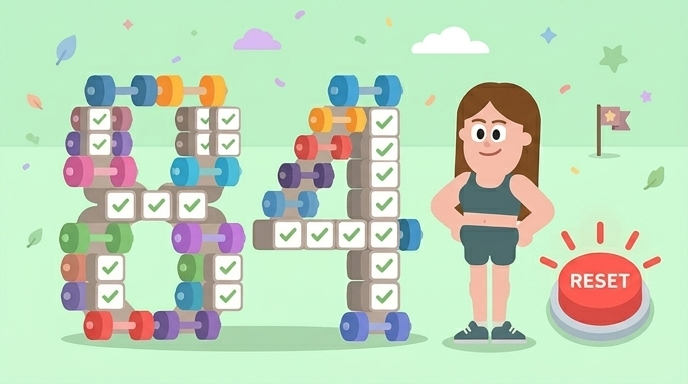
The 84-Day Reset: A Realistic Alternative to 75 Hard
75 Hard works for some people. For most, it breaks them. Here's a science-backed 84-day alternative built for sustainability instead of suffering.
75 Hard has a cult following for a reason. It's brutal, binary, and the rules are non-negotiable: two 45-minute workouts a day (one outdoors), no alcohol, a strict diet, a gallon of water, ten pages of a non-fiction book, and a daily progress photo — for 75 days straight. Miss one rule, one day, and you start over from day one.
For some people, that all-or-nothing structure is exactly the wake-up call they need. For most, it's a recipe for a 23-day flame-out followed by months of guilt. This article isn't here to bash 75 Hard. It's here to offer a smarter alternative for the 90% of people who want a real reset without breaking themselves on day 24.
"The hardest program isn't the best program. The one you finish is."
What 75 Hard actually demands
75 Hard was created by entrepreneur Andy Frisella as a "mental toughness program" — explicitly not a fitness program. The daily rules:
- Two workouts of 45 minutes each, every day
- One of those workouts must be outdoors, regardless of weather
- Follow a strict diet — no cheat meals, no alcohol
- Drink one gallon (≈3.8L) of water per day
- Read 10 pages of a non-fiction / self-improvement book daily
- Take a daily progress photo
- Miss any rule on any day → restart from day 1
That's roughly 90 minutes of training, 5+ hours of additional logistics, and zero margin for life events — for 75 consecutive days.
Why most people fail it
There's no official completion data, but unofficial polls and Reddit communities consistently put the dropout rate above 75%. The reasons cluster:
- The restart rule is psychologically devastating. Missing day 32 means losing 31 days of progress. Most people don't restart — they quit.
- Two workouts per day is incompatible with most jobs and parents. It's not "discipline" that breaks people; it's geometry.
- No deload, no recovery. Sports science is clear: structured recovery improves long-term outcomes.
- Binary rules ignore the 80/20 of behaviour change. Sustainable change needs flexibility, not perfection.
- The diet is undefined. "Pick a diet and stick to it" with no nutritional guidance leads many people into under-eating.
For people with a strong fitness base and a clear schedule, 75 Hard can work. For everyone else, the program is engineered to fail them — then make them feel like the failure was theirs.
The case for an 84-day window
Why 84 days? Because it lines up with what the actual habit-formation research says. The seminal Lally et al. (2009) study found that habits take an average of 66 days to become automatic, with complex behaviours like training sitting on the slower end of the curve.
84 days — exactly 12 weeks — gives you:
- Enough time for habits to genuinely automate
- A clean structure: 12 weeks = 4 progressive 3-week mesocycles
- Built-in deload weeks every 3 weeks for sustainable progression
- Room for life: 1–2 missed sessions per month don't reset anything
- A horizon long enough to see real body composition changes (see realistic timelines)
It's long enough to be transformative. Short enough to be finishable.
Daily structure of an 84-Day Reset
A sustainable reset doesn't need 6 hours a day. It needs the right things, done consistently:
1 workout per day (30–45 min)
Strength 3×/week, cardio or mobility 2–3×/week, 1 full rest day.
Hydration adjusted to bodyweight
Roughly 30–35 ml per kg, not a one-size-fits-all gallon.
Sensible nutrition, not extreme
Protein target, mostly whole foods, alcohol limited but not banned.
Sleep window
7–9 hours, consistent bedtime. The most underrated performance variable.
Weekly check-in, not daily photos
One photo, one set of measurements, one honest reflection per week.
How to build it without an app
You don't need software to do this. You need a calendar, a notebook, and a plan.
- Print a 12-week calendar. Tape it somewhere visible.
- Pick your 5 weekly training slots and pre-write them in.
- Build a simple progressive plan (or use this beginner template).
- Cross off each day completed. Don't break the chain — but if you do, continue, don't restart.
- Every Sunday: 10 minutes to log weight, one photo, one note about how you felt.
- Every 3 weeks: take an easier "deload" week. Lower volume, same days.
That's it. No paid program required.
How Fytly automates it
If you don't want to design and manage the structure yourself, Fytly's 84-Day Reset does it for you:
- AI generates your weekly plan based on your goal, equipment, and time
- Built-in deloads every 3 weeks so you don't burn out
- Streaks and XP make daily showing-up feel like a win
- "Bad day mode" — a 10-minute fallback session that still counts toward your streak
- Weekly check-in flow with photo + measurements in under 2 minutes
- No restart penalty — life happens, the program adjusts
Try the 84-Day Reset.
A 12-week structure built for real life — not Instagram challenges.
Download Fytly →Frequently asked questions
Is the 84-Day Reset easier than 75 Hard?
It's more sustainable, not necessarily easier. You still train 5–6 days a week for 12 weeks, but with one workout per day, scheduled deload weeks, and no restart penalty.
Why 84 days instead of 75 or 90?
84 days = 12 weeks = four 3-week mesocycles, which matches how strength programs are typically structured. It also sits past the 66-day habit-formation average from Lally et al. (2009).
What happens if I miss a day on the 84-Day Reset?
You continue. You don't restart. The streak system in Fytly accommodates this by offering a 10-minute fallback session for low-energy days, so the chain stays intact.