AI Workout Plans: What They Get Right and What They Get Wrong
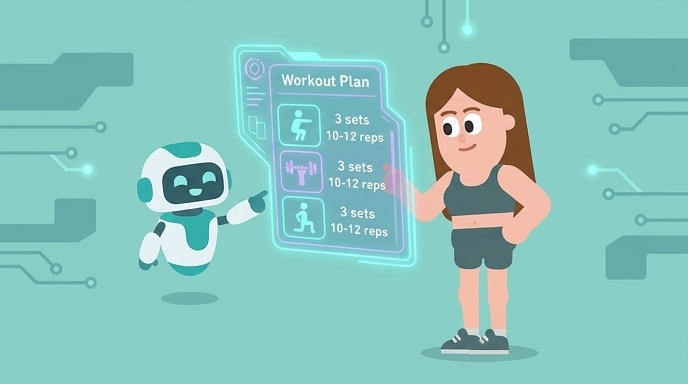
AI can build you a smarter, faster, more personalised workout plan than most templates online. It also can't watch your form. Here's the honest verdict.
Five years ago, "AI workout plan" meant a slightly randomised PDF. Today, large language models can take your goal, equipment, schedule, and history and spit out a structured 12-week program in seconds — one that would have cost you €200 from a coach in 2019.
That's a real shift. But it's also a marketing playground, and most of what's sold as "AI personal training" is closer to autocomplete than coaching. This article is an honest evaluation of what AI workout plans actually do well, where they fall short, and how to use them without getting suckered.
"AI is a great planner. It is not, yet, a great coach."
How AI workout generators work
Under the hood, most AI workout tools are doing one of two things:
- Rule-based generation. A library of exercises is filtered and combined according to your inputs using fixed programming logic. The "AI" is largely a wrapper around a coach-built decision tree.
- LLM-driven generation. A large language model writes a plan in natural language using its training data. More flexible, more conversational — but also more prone to hallucination without good prompting.
The best apps combine both: an LLM for personalisation and clarity, plus rule-based scaffolding to make sure the program actually follows sound training principles.
What AI does well
Personalisation at scale
A single template program ignores 90% of what makes a plan stick: your schedule, your equipment, your injury history, your goal. AI handles all of that in seconds.
Adaptive progression
Modern AI tools can adjust loads, reps, and exercises based on weekly check-ins. Hit your top set easily? Loads go up. Missed reps two sessions in a row? Volume drops.
Speed and cost
A custom 12-week program from a qualified coach typically costs €100–€400. AI delivers a comparable structural plan in under a minute.
Removing the planning tax
Many people quit training not because they can't do the workouts, but because they can't decide what to do. Removing that decision (covered in our adherence article) is one of AI's most underrated wins.
What AI gets wrong
Form and technique
A printed plan can't see you squat. AI can tell you to do 3×8 Romanian deadlifts; it can't tell that your spine is rounding at rep 5. Computer-vision form analysis is improving (research is promising) but is still a long way from coach-level cueing.
Real-time judgement
A good coach watches your bar speed, sees you yawn between sets, asks how you slept, and adjusts on the spot. AI works from what you tell it.
Injuries and individual quirks
AI can avoid exercises you flag as painful — but it can't diagnose why something hurts. For anything beyond minor niggles, a physical therapist or coach beats any algorithm.
Recovery and life context
AI optimises within the time you give it. It doesn't know your toddler kept you up for three nights. Without honest input, the output drifts.
When AI beats a human coach
- You're a beginner who needs structure more than nuance
- You can't afford ongoing coaching
- You train alone, at home, with limited equipment
- Your goal is general fitness or fat loss, not competitive sport
- You want to follow a plan rather than design one
- You need quick replanning when life or equipment changes
For 80% of casual gym-goers, an AI-generated plan applied consistently outperforms a "perfect" template applied half the time.
When AI doesn't beat a coach
- You're training for a sport with technical skills (Olympic lifting, gymnastics, climbing)
- You're rehabbing a serious injury
- You're an advanced lifter chasing fine-margin gains
- You need accountability from a human, not a notification
- Your form on key lifts is unsafe or inefficient
In those cases, the right move is to use AI for the plan and pay a coach for periodic form checks — best of both.
How to use AI as structure, not a replacement
The most effective approach for most people:
- Let AI build your weekly structure based on your goal, time, and equipment.
- Use video tutorials (or one-off coach sessions) to learn the key exercises properly.
- Log every session honestly — fatigue, sleep, soreness — so the AI can adapt.
- Re-generate the plan every 4–6 weeks, or use an app that adjusts automatically.
- Track outcomes that matter (strength, body composition, energy) — not just compliance.
This is exactly how Fytly uses AI: as the engine that builds your plan, adjusts it based on adherence and feedback, and removes the daily decision of "what should I do today?" — wrapped in a gamified system that keeps you actually doing it.
An AI plan you'll actually follow.
Fytly builds your plan in seconds and uses streaks, XP, and a bad-day mode to keep adherence high.
Download Fytly →Frequently asked questions
Are AI workout plans actually good?
For most casual lifters, yes — provided the tool combines an LLM with rule-based programming logic. AI is excellent at personalising structure and removing the daily planning tax. It's weakest at coaching form.
Can AI replace a personal trainer?
For program design, increasingly yes. For form coaching, injury rehab, and high-level sport-specific work, no. The best approach is to use AI for the plan and book occasional coach sessions for technique audits.
How do I get the best results from an AI workout app?
Be honest with your inputs (time, equipment, sleep, soreness), log sessions consistently so the AI can adapt, learn the form for compound lifts from video or a coach, and re-generate the plan every 4–6 weeks.