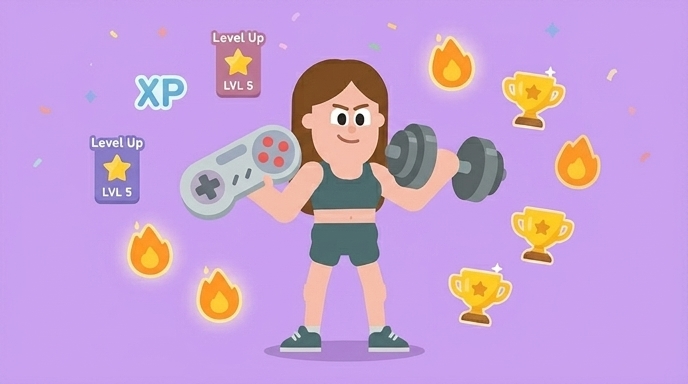
Gamified Fitness Apps: Why Turning Workouts Into a Game Actually Works
Streaks, XP, and level-ups aren't gimmicks. They're the most reliable way to convert short-term motivation into long-term behaviour change. Here's the science.
Duolingo turned grammar drills into one of the most-used apps on the planet. Strava turned solo runs into competitive entertainment. Apple's activity rings made closing three coloured circles feel like a personal moral obligation.
None of those products invented exercise or language learning. They invented better behavioural delivery systems for things humans already wanted to do but rarely stuck with. That's gamification — and when applied correctly to fitness, it's not a gimmick. It's the missing layer between intention and action.
"You don't lack motivation. You lack a feedback loop that rewards showing up."
What gamification actually means in fitness
Gamification is the use of game-design elements — points, levels, streaks, quests, rewards, leaderboards — in non-game contexts. In fitness apps, it usually shows up as:
- XP earned per workout, weighted by intensity or duration
- Levels unlocking new programs, achievements, or cosmetic rewards
- Streaks — consecutive days of activity
- Badges / achievements for milestones (first 10 workouts, first 5K, etc.)
- Quests / challenges — short-term goals with completion rewards
- Leaderboards or social comparison features
Done well, these elements turn invisible effort into visible progress and convert long-term goals into short-term wins.
The dopamine and progression loop
The brain runs on prediction. When you anticipate a reward, dopamine is released — not when the reward arrives, but when you expect it. This is the engine of every game ever made: not the prize, but the anticipation of the prize.
Research on gamification in health behaviour consistently shows that adding game elements increases adherence — typically by 20–40% — particularly during the fragile first weeks when habits are still forming.
A workout app without progression feels like data entry. A workout app with progression feels like a save file you don't want to lose.
Examples from Duolingo and Strava
Duolingo
Duolingo's streak feature is so psychologically powerful it's spawned memes. The owl mascot, streak freezes, the panic when you almost lose a 400-day streak — none of that teaches you Spanish. But it does get you to open the app, which is the prerequisite for everything else.
Strava
Strava turned solo cycling and running into a quasi-multiplayer experience. Segment leaderboards, kudos, club challenges — none of which improve your VO₂max directly, but all of which dramatically increase the probability you'll go out for tomorrow's ride.
Apple Activity Rings
Three rings. Three goals. Close them every day. The genius is the simplicity — and the way perfect weeks become a kind of internal trophy. Streak-driven users move significantly more than non-streak users.
Why streaks beat reminders
A reminder is a push. A streak is a pull. The difference matters.
A reminder triggers a single decision: "Should I work out now?" — drawing from finite willpower (covered in detail here). A streak triggers loss aversion: "I've gone 19 days. I cannot let it become 0."
Loss aversion is, behaviorally, about twice as powerful as reward-seeking. That's why "don't break the chain" outperforms "remember to work out" — by a wide margin.
The pitfalls of bad gamification
Gamification done badly is worse than no gamification at all. Common failure modes:
- Empty XP. Points that don't unlock anything become meaningless within a week.
- Punitive streaks. Lose your streak after one missed day and most users never return.
- Toxic leaderboards. Public rankings demotivate the bottom 80% of users.
- Cosmetic-only rewards. Avatar skins don't replace meaningful feedback on actual progress.
- Compulsion loops. Notifications engineered to manipulate, not support.
Good gamification supports the goal. Bad gamification replaces it.
What a well-designed system looks like
The best gamified fitness systems share a small set of properties:
- Streaks with mercy. Streak freezes or low-effort fallback sessions so one bad day doesn't undo the habit.
- Progress that means something. XP that unlocks new programs or harder workouts.
- Personal-best comparison, not public ranking. You vs. last month, not you vs. strangers.
- Tied to outcomes that matter. Body composition, strength PRs, mood/energy logging.
- Optional, not coercive. Notifications you control, not addictive loops.
This is exactly the design philosophy behind Fytly. XP, streaks, level-ups, and a 10-minute "bad day mode" that keeps the chain intact — all wrapped around an AI-built training plan you can actually stick to.
Make showing up the win.
Fytly is a gamified fitness app built around streaks, XP, and AI-personalised plans.
Download Fytly →Frequently asked questions
Do gamified fitness apps actually work?
Yes. Meta-analyses show 20–40% improvements in adherence, particularly during the fragile first 8 weeks of a new habit.
Why are streaks so effective?
Streaks trigger loss aversion, a cognitive bias roughly twice as powerful as reward-seeking. The desire not to break a 14-day chain outweighs the friction of doing today's workout.
What makes a gamified fitness app good vs. gimmicky?
A good system rewards consistent showing-up, allows for human imperfection (rest days, fallback sessions), and ties progress to real outcomes. A gimmicky one hands out empty XP and punishes you for being human.