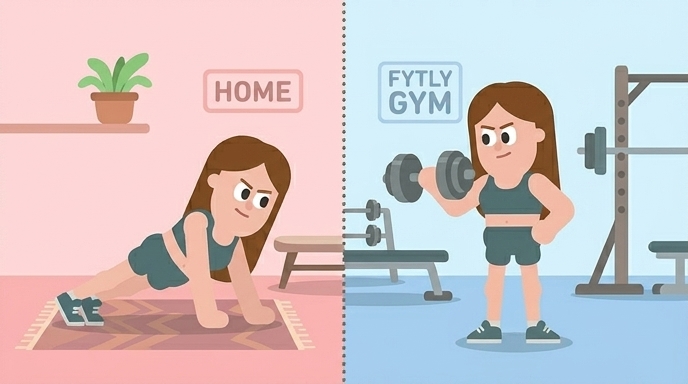
Home Workouts vs Gym Workouts: Which One Builds More Consistency
Home workout vs gym — which one actually keeps you consistent? We compare cost, adherence rates, equipment limits, and social factors to help you decide (or combine both).
The home workout vs gym debate isn't really about which builds more muscle — both can. It's about which one you'll actually do for the next twelve months. Consistency, not intensity, is the variable that separates results from regret. (See our deep dive on how long it takes to build a workout habit.)
Let's compare them honestly using data, not gym-bro opinions.
Cost and Access
The math is simple but lopsided.
- Gym: $30–80/month, plus commute time (avg. 17 minutes round trip per U.S. fitness data).
- Home: One-time spend of $150–500 for resistance bands, adjustable dumbbells, and a mat. Zero commute.
Over a year, home is roughly 70% cheaper. Over five years, it's not even close.
Adherence Rates
This is where it gets interesting. A 2012 study in the Journal of Behavioral Medicine found that home exercisers had higher 12-month adherence (63%) than gym members (47%). The reason? Friction. Every minute of commute, every "is the gym crowded?" thought, is an excuse waiting to happen — exactly the trap we cover in why you keep quitting the gym.
However, gymgoers who attend with a partner or trainer flip the script — their adherence jumps above 70%.
Equipment Limits
You can absolutely build muscle at home with bands, dumbbells, and bodyweight. But there's a ceiling. After about 12–18 months of progressive training, most people hit a plateau where heavy barbell work (squats, deadlifts, bench) becomes hard to replicate without a rack.
Gyms also unlock cable machines, leg press, and specialty equipment that hit muscles at angles bodyweight can't reach. Use the One Rep Max Calculator to track when you've outgrown your home setup.
Social Factors
Humans are social creatures. The gym offers:
- Visible peer accountability ("everyone else is here, so I'll show up")
- Casual community and conversation
- Trainers and form-checks on demand
Home offers:
- Zero social pressure (a plus for introverts)
- Privacy to fail and learn
- Family integration (workouts during nap time, between meetings)
- Easy integration of desk-friendly micro-workouts during the workday
Which Wins for Which Goal
- General health and longevity: Home wins. Lower friction = more sessions completed.
- Maximum muscle and strength: Gym wins. Heavy progressive overload requires a rack.
- Fat loss: Tie. Both work if calories and protein are dialed in — calculate yours with the TDEE Calculator and Macro Calculator.
- Athletic performance: Gym, but plyometrics and conditioning translate well at home.
- Habit-building (first 90 days): Home, every time. Lower friction wins. Pair it with the 84-Day Reset framework.
How to Combine Both
The smartest approach for most people: hybrid training.
- 2 gym sessions per week for compound lifts and machine work
- 1–2 home sessions for mobility, accessory work, or cardio
- Daily 10-minute movement at home (the streak-builder)
Fytly supports both modes natively — your workout plan adapts to whichever location you check into, so you never lose a streak just because the gym is closed. Curious how the streak system survives life? Read why your workout streak keeps breaking.
Frequently Asked Questions
Can I build real muscle working out at home?
Yes — for the first 12–18 months, bodyweight, bands, and adjustable dumbbells produce nearly identical hypertrophy gains as a gym, provided you progressively overload (more reps, harder variations, slower tempo).
Is the gym worth it if I rarely go?
No. If you're attending fewer than 6 times per month, switch to home for 90 days, build the habit, then re-evaluate.
What's the minimum home gym setup?
Two adjustable dumbbells (5–50 lbs), one set of resistance bands, and a yoga mat. Total cost: under $300. This covers 90% of an intermediate program.
Does Fytly work for both home and gym?
Yes. Fytly auto-adjusts your plan based on the equipment you have available and tracks your streak across both environments.