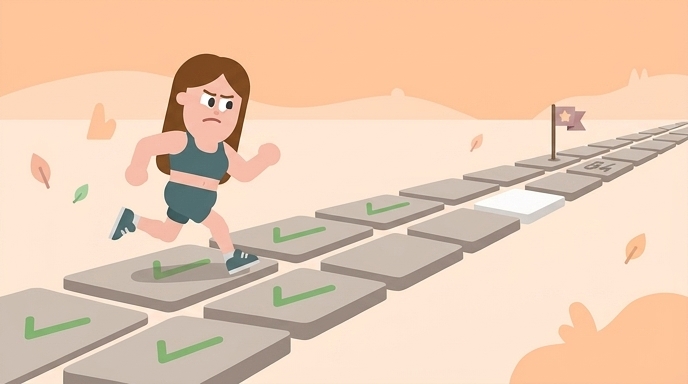
How Long Does It Really Take to Build a Workout Habit?
The 21-day rule is a marketing myth. Real research puts habit formation at an average of 66 days—and fitness habits often take longer. Here's the honest timeline.
"It takes 21 days to build a habit." You've heard it on every podcast, in every self-help book, on every fitness influencer's reel. It's clean, it's catchy — and it's wrong.
The 21-day number didn't come from research. It came from a 1960s plastic surgeon who noticed his patients took about three weeks to get used to their new face. Somehow that became the universal habit law. The actual science is more honest, more useful, and — for fitness — more demanding.
"Habit formation is a process, not an event. The question isn't how long — it's how many reps before it runs on autopilot."
The 21-day myth, debunked
The "21 days" claim traces back to Dr. Maxwell Maltz's 1960 book Psycho-Cybernetics. He observed that amputees took roughly 21 days to stop feeling a phantom limb, and that his cosmetic-surgery patients took about the same time to get used to their appearance. He wrote: "It requires a minimum of about 21 days..."
The word "minimum" got dropped. The word "habit" got added. And a marketing legend was born.
In reality, no peer-reviewed study has ever supported a fixed 21-day window for habit formation. The closest thing we have to a real number comes from a 2009 study by Phillippa Lally at University College London — and that number is much bigger.
What research actually says
In Lally et al. (2009), 96 participants chose a new daily behaviour and reported each day whether they'd done it and how automatic it felt. The results:
- Average time to automaticity: 66 days
- Range: 18 to 254 days, depending on the behaviour and the person
- Simple habits (drinking a glass of water after breakfast) formed faster
- Complex habits (50 sit-ups before lunch) took dramatically longer
Translation: a sip of water might lock in within a few weeks. A workout — which involves changing clothes, travelling, exerting effort, recovering, and scheduling — sits firmly on the slower end of that curve.
Why fitness habits take longer than other habits
Drinking water after breakfast costs you nothing. A workout costs you time, energy, comfort, and often dignity (if you're new). That cost matters. The brain is a cost-benefit machine — and behaviours with high upfront cost need more reps before they automate.
- Higher friction. Multiple steps: clothes, gear, travel, recovery.
- Delayed reward. Visible results lag 6–12 weeks behind effort (see realistic timelines here).
- Physical discomfort. Soreness, fatigue, and breathing hard are not naturally rewarding.
- Schedule disruption. Training competes with work, sleep, and social life.
For most people, the realistic window for a workout habit to feel automatic — meaning you do it without negotiating with yourself — is 10 to 14 weeks of consistent practice. Roughly 70 to 100 days.
The role of streaks and identity shift
There's something habit research and gamification both agree on: visible streaks accelerate identity shift. The longer your unbroken chain, the more "I am someone who trains" replaces "I'm trying to train".
Identity-based habits — popularised in James Clear's Atomic Habits — are stickier because every session becomes evidence for who you are, not just a task on a list. Missing one day stops feeling like a small failure and starts feeling like a contradiction of self.
This is why apps with streaks, calendars, and visible progress outperform plain trackers. Not because the streak itself matters, but because it gives the brain an external mirror of identity in motion.
A realistic 84-day framework
If 66 days is the average for simple habits and fitness sits at the harder end, an 84-day window (12 weeks) is a defensible, research-backed target for building a workout habit that survives without willpower.
Days 1–28 — Construction
Show up, even badly. Focus on attendance, not performance. Build the cue (same time, same trigger). Expect resistance.
Days 29–56 — Reinforcement
Strength gains become noticeable. Sessions feel less heroic. The internal voice shifts from "should I?" to "when?".
Days 57–84 — Automation
Training feels like a non-event. Missing a session feels weirder than doing one. Identity has shifted: you are someone who trains.
This is the exact framework behind Fytly's 84-Day Reset — a structured, gamified 12-week program designed to take you from "trying to start" to "this is just what I do now", with streaks, AI-adjusted plans, and built-in flexibility for bad days.
Build the habit in 84 days.
Fytly's 84-Day Reset is a science-backed structure for people who've started over too many times.
Start your 84-Day Reset →Frequently asked questions
How long does it really take to build a workout habit?
Research from University College London (Lally et al., 2009) puts the average at around 66 days for simple habits, with a range of 18 to 254 days. Fitness habits typically sit at 70 to 100 days. A practical target is 84 days (12 weeks).
Is the 21-day habit rule true?
No. The 21-day claim comes from a 1960 plastic-surgery observation by Dr. Maxwell Maltz, not from habit research. No study has ever supported a fixed 21-day window.
What helps a workout habit stick faster?
Three things: a fixed cue (same time, same trigger), a visible streak that reinforces identity, and a minimum viable session you can do on your worst day so the chain never breaks.