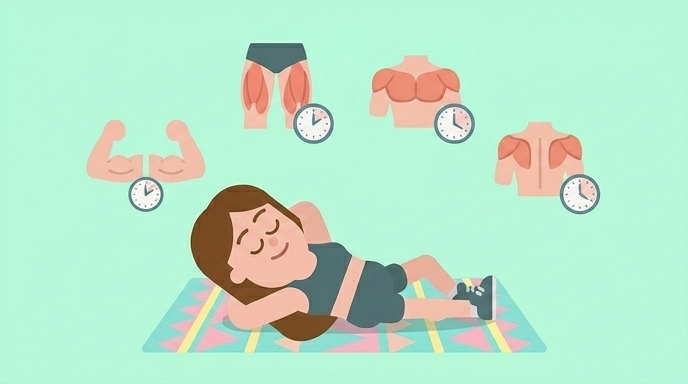
Muscle Recovery 101: How Long Each Muscle Group Actually Needs
Muscle recovery time by group — how often to train legs, back, chest, arms, shoulders, and core. Plus signs you are overtrained, and how AI tracks recovery automatically.
Most beginners train too often. Most intermediates train too little. The truth lives in the middle, and it depends entirely on the muscle group. Understanding muscle recovery time per group is the difference between steady progress and a 6-month plateau.
Here's the science-backed breakdown of how long each major muscle group actually needs. (For programming context, pair this with our weekly beginner routine and beginner gym guide.)
What Recovery Actually Means
Recovery isn't just about soreness fading. It's the rebuilding of muscle protein, the replenishment of glycogen, and the resetting of your central nervous system. According to a 2020 review in Sports Medicine, full muscle protein synthesis takes 24–72 hours depending on training intensity, age, and the muscle's size.
Bigger muscles, heavier loads, more eccentric work = longer recovery.
Recovery Time by Muscle Group
Here's the typical range for a moderately trained adult performing 6–10 working sets to near-failure:
- Legs (quads, hamstrings, glutes): 48–72 hours. Largest muscle group, longest recovery.
- Back: 48–72 hours. Heavy compound work hits CNS hard.
- Chest: 48 hours. Recovers slightly faster than back.
- Shoulders: 24–48 hours. Smaller muscle, faster recovery, but easy to overtrain due to indirect work from chest/back day.
- Arms (biceps, triceps): 24–48 hours. Get hit indirectly during pulls and presses.
- Core: 24 hours. Designed for high-frequency work (think postural endurance).
This is why most well-designed splits train each muscle group 2x per week — enough frequency to drive growth, enough rest to recover. To know how much weight to use, the One Rep Max Calculator helps you set safe working loads.
Signs You Are Undertrained or Overtrained
Undertrained signals:
- You're never sore, even after sessions
- Strength is stagnant for 4+ weeks (see realistic fitness results for normal progress timelines)
- Sessions feel "too easy"
Overtrained signals:
- Persistent soreness lasting more than 5 days
- Sleep quality drops
- Resting heart rate elevated 5+ bpm above baseline
- Mood and motivation crash for no clear reason
If you see 2+ overtraining signals, take a deload week (50% volume, same intensity). Your next session will feel dramatically stronger — and your streak stays intact if you log mobility work.
Sleep, Protein, and Stress
Three multipliers determine how fast you actually recover:
- Sleep: 7–9 hours. Sub-6 hours cuts muscle protein synthesis by ~18% per research in PLOS One.
- Protein: 1.6–2.2g per kg of bodyweight. Calculate yours with the Macro Calculator and check daily energy needs with TDEE.
- Stress: Chronic cortisol blunts recovery. Manage with mobility, walks, and the stress-reducing power of exercise — see exercise for anxiety.
How AI Can Track Recovery for You
Manually tracking soreness, sleep, and volume per muscle group is tedious. AI-driven apps like Fytly do it automatically — and as we cover in AI workout plans: what they get right and wrong, recovery prediction is where AI shines:
- Per-muscle-group fatigue scoring
- Adaptive plans that delay sessions when recovery isn't complete
- Auto-deload weeks when overtraining markers appear
This is the unsexy part of training that drives 80% of long-term results — and it's the exact problem Fytly's recovery logic was built to solve. New here? Check out the full free fitness calculator suite.
Frequently Asked Questions
Can I train the same muscle two days in a row?
Only if intensity is low. Two heavy back-to-back sessions on the same muscle group consistently leads to overuse injury and stalled growth.
How do I know if I've fully recovered?
Three checks: no lingering soreness, strength matches or exceeds last session, and motivation to train is present. If two of three are missing, rest one more day.
Should I train through soreness?
Mild soreness (2–4/10) — yes, blood flow speeds recovery. Significant soreness (5+/10) — train a different muscle group, not the sore one.
How does Fytly track recovery by muscle group?
Fytly logs the volume and intensity per muscle group each session, then applies recovery models to suggest your next session, deload, or active recovery day automatically.