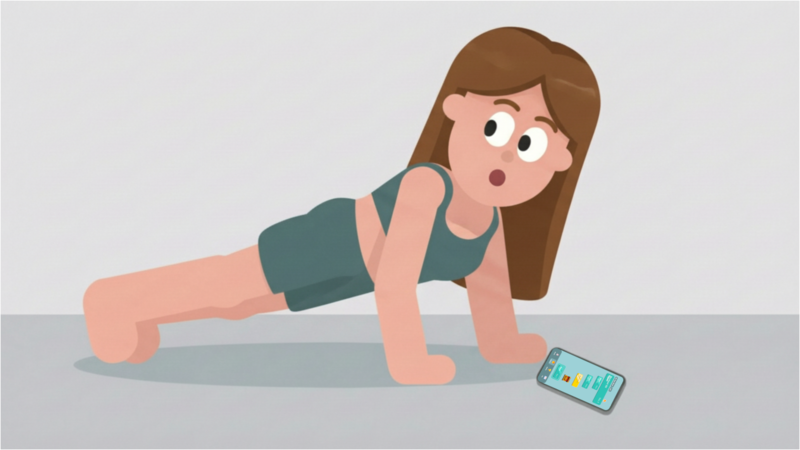
Weekly Workout Routine for Beginners (That Survives Real Life)
You don't need a perfect plan. You need a weekly routine that survives bad sleep, late meetings, and 'I really don't feel like it today.'

Weekly Workout Routine for Beginners (That Survives Real Life)
You don't need a perfect plan. You need a weekly routine that survives bad sleep, late meetings, random invitations, and "I really don't feel like it today."
This guide gives you a practical 3–4 day at-home routine for absolute beginners – plus a simple rule for what to do when you miss a day so you don't lose motivation.
Why Most Beginner Routines Fail After Week 1
If you've ever:
- started a new program on Monday,
- smashed days 1–3,
- missed one day,
- and then… ghosted the gym for two weeks,
you're not alone.
Most beginner workout plans fail for three simple reasons:
- They assume your week is perfect. No delays, no stress, no extra work.
- They demand too much, too soon. Six days per week, long sessions, complicated exercises. Research shows that exercise adherence drops when intensity is too high too quickly.
- They treat a missed day as failure. So you restart instead of continue.
A routine that survives real life does the opposite:
- It fits into busy weeks.
- It uses simple exercises you can do at home.
- It assumes you'll miss days – and has a rule for what happens next. (We borrowed this from the 84-day comeback challenge system.)
That's what we'll build.

The Principles of a Realistic Beginner Weekly Routine
Before we jump into the exact plan, lock these simple rules in:
1. 3–4 workout days per week is enough.
You're a beginner, not a full-time athlete. Aim for 3 solid days, optionally a 4th "bonus" day if you feel good.
2. 30–40 minutes per session.
That's long enough to matter and short enough to fit into a messy day.
3. At home, minimal or no equipment.
Bodyweight exercises are perfect to build a baseline. If you have dumbbells or bands, great – they're a bonus, not required.
4. Full-body focus.
Each session trains multiple muscle groups so if you only manage 2–3 days, you still trained your whole body.
5. Clear rule for missed days.
We'll use this:
Missed a workout? Don't restart. Just do the next planned session on your next available day.
This is also how setShowPopup(true)} class="text-primary font-semibold hover:underline cursor-pointer" > Fytly's AI-Coach thinks: it doesn't punish you with a restart; it adjusts the plan around your actual life instead of a fantasy calendar.
Your 3–4 Day Beginner At-Home Weekly Plan
You can start with 3 days. If you're feeling good after week 1–2, add the optional Day 4.
Think of them as Workout A, B, C, (D) – not tied to specific weekdays. You just move through them in order.
Warm-Up (5 minutes for every session)
Do this before each workout:
- March in place or walk around briskly – 1–2 minutes
- Arm circles forward/backward – 30 seconds each
- Hip circles – 30 seconds
- 10 bodyweight squats
- 10 easy push-ups (on knees or against a wall)

Workout A – Full Body Basics
Goal: Learn basic movement patterns and wake everything up.
Do 2–3 rounds (circuits). Rest 45–60 seconds between rounds.
- Squats (bodyweight) – 10–12 reps
- (Wall) Push-Ups – 8–10 reps
- Glute Bridges – 10–12 reps
- Dead Bugs (core) – 8–10 reps per side
- Standing Shoulder Taps (hands on wall) – 10 per side
If you finish 2 rounds and feel okay, add a 3rd. If 2 is already challenging, stay there – consistency beats overdoing it.

Workout B – Lower Body + Core
Do 2–3 rounds.
- Reverse Lunges (hold a chair for balance if needed) – 8–10 reps per leg
- Bodyweight Squats – 10–12 reps
- Calf Raises (on flat ground) – 12–15 reps
- Side Plank (knees) – 20–30 seconds per side
- Dead Bug or Bird Dog – 8–10 reps per side
If lunges are too hard, shorten the step or do stationary split squats holding onto a wall or chair.

Workout C – Upper Body + Core
Do 2–3 rounds.
- Incline Push-Ups (hands on a table/counter) – 8–10 reps
- Bent-Over Backpack Rows (use a backpack with books) – 10–12 reps
- Shoulder Taps (in high plank or on wall) – 10 per side
- Glute Bridge March – 8–10 reps per leg
- Dead Bug – 8–10 reps per side
The goal is to feel "worked" but not destroyed. You should be able to talk during most of the session, just a bit out of breath.

Optional Workout D – "Movement Snack" Day
If you feel recovered and have energy, add this as a 4th day.
Set a timer for 20 minutes and rotate:
- 20 jumping jacks (or step jacks if impact is an issue)
- 10 bodyweight squats
- 10 wall push-ups
- 20 seconds plank (on knees if needed)
- 30 seconds of marching in place
Move at a comfortable, steady pace. It should feel more like a long warm-up or light circuit, not a max-effort workout.

How to Use This Plan in a Real, Messy Week
Here's where most plans break… and where yours survives.
1. Don't assign fixed weekdays at first
Instead of saying:
- Monday = Workout A
- Wednesday = Workout B
- Friday = Workout C
…think:
- Next session = A
- Then B
- Then C
If Monday explodes and you can't train, you simply do Workout A on Tuesday. No guilt, no restart. Btw that is also how your AI-Coach structures your workout plans in the FytlY App.
2. Use a simple "Next Session Rule"
Your rule: Whenever you have ~30 minutes, do the next workout in the sequence.
So your week might look like this:
- Monday: too busy → do nothing
- Tuesday: Workout A
- Thursday: Workout B
- Saturday: Workout C
That's still 3 solid sessions. You're winning.
3. If you miss a whole week, don't start from zero
If you disappear for a week, don't punish yourself with a totally new "Day 1." Just:
- Do Workout A the next time you're ready.
- If everything feels fine, go back to rotating A → B → C.
If you feel very deconditioned, drop to 1–2 rounds per workout for a week, then build back up.
This is exactly the mindset Fytly builds in: you're not a failure because you missed days; the plan adapts and keeps moving forward.
How Fytly's AI-Coach Auto-Adjusts When You Miss a Day
Doing this manually is possible, but annoying. You have to:
- remember what the "next" workout is,
- adjust if you're more tired than usual,
- and not be too harsh on yourself after breaks.
Fytly's AI-Coach is built specifically to solve that.
Here's what it does in practice:
1. Tracks your actual week, not the ideal one.
If you planned 3 days and only trained twice, it doesn't yell at you. It just mines that info for future decisions.
2. Reschedules your "next best" session.
Missed your planned lower-body day? The app will push it forward and adjust the sequence, so you still hit everything over the next few sessions instead of trashing the whole week.
3. Adjusts intensity based on reality.
If you had a stressful week or a bad night's sleep and tell the app, it can scale down volume or difficulty instead of forcing a heavy session when you're already drained.
4. Stops the "Day 1 again" pattern.
Instead of sending you back to some rigid Day 1, it treats your current state as the starting point. You continue from where you are, not where the template thought you would be.
Mentally, this is huge. It removes the constant feeling that you've "fallen behind" and lets you build a habit even if life is chaotic.

Basic Safety Note
If you:
- have any medical conditions,
- haven't exercised in a long time,
- or feel pain (not just normal muscle fatigue) during any movement,
it's a good idea to talk to a doctor or qualified professional before pushing harder. Start slower, reduce reps/sets, and focus on learning the movements with control.
The Real Win: Stop "Starting Over" – Just Keep Going
You don't need a 6-day advanced program. You need:
- a simple 3–4 day weekly plan,
- exercises you can perform at home with no equipment,
- and a system that keeps going even when you miss days.
Start with the routine above. Use the "next session rule." Don't restart every Monday – continue. Looking for more structure? Check out our desk exercises for office workers to stay active throughout your day.
If you want help with the tracking, adjusting, and motivation part, Fytly's AI-Coach is designed for exactly this: to adapt your plan to your real life, not punish you for living it.