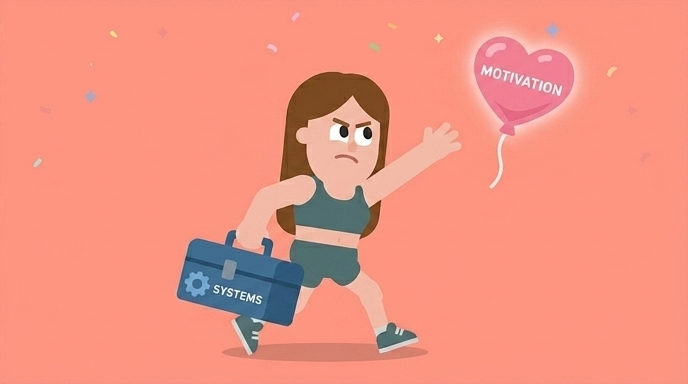
Why Motivation Fails (And What to Use Instead)
Why motivation fails: it is a feeling, not a strategy. Here is the neuroscience behind motivation decay and what to use instead — systems, identity, and environment design.
Every January, gyms fill up. By mid-February, they're empty again. The problem isn't that people are weak or lazy — it's that they bet their fitness on the wrong currency. Why motivation fails comes down to one truth: motivation is a feeling, and feelings are unreliable.
The people who stay consistent for years don't have more willpower. They have better systems. We've covered the same theme from different angles in why you keep quitting the gym and how long it takes to build a workout habit.
Motivation Is a Feeling, Not a Strategy
Motivation is dopamine-driven anticipation. It spikes when you imagine the result (the body, the energy, the confidence) and crashes the moment the work gets boring or hard. Building a fitness routine on motivation is like building a house on weather — sunny days are easy, but the house collapses in the storm.
The Neuroscience of Motivation Decay
Research from Nature Reviews Neuroscience shows dopamine response to a reward decreases by roughly 50% after the first few exposures. This is called "habituation." The thrill of your new gym membership, your new running shoes, your new program — it all fades within 14–21 days.
That's why the most common quit point isn't day 3. It's day 17 — exactly when your workout streak tends to break.
What Replaces It: Systems, Identity, Environment
Three things outperform motivation in every long-term study of behavior change:
- Systems — Pre-decided routines so you don't negotiate with yourself daily.
- Identity — "I'm someone who trains" beats "I want to get fit." Identity sticks; outcomes don't.
- Environment — The space around you does 80% of the work. Visible cues, accessible equipment, scheduled time blocks.
Designing Your Environment
Make the right action obvious and the wrong action invisible:
- Lay out workout clothes the night before.
- Put resistance bands in plain sight, not in a drawer.
- Schedule training as a non-negotiable calendar block.
- Remove apps and snacks that compete with the habit.
- If you sit all day, embed desk-friendly exercises into your workday.
James Clear calls this "choice architecture." It works because it doesn't require willpower — it requires a single setup decision.
How Streaks and Small Wins Compound
The brain loves momentum. A 5-day streak releases more dopamine than the workouts themselves. This is the entire psychological foundation of why gamified fitness apps work — they convert invisible progress into visible progress. And exercise itself becomes a mood regulator: see exercise for anxiety.
Fytly is built on this principle. Instead of asking "are you motivated today?" it asks "did you keep your streak?" That tiny reframing — from feelings to evidence — is what separates a 3-week attempt from a 3-year transformation.
Start by checking your baseline: BMR, TDEE, and macros. Then let the Fytly system run quietly in the background while motivation comes and goes.
Frequently Asked Questions
What's the difference between motivation and discipline?
Motivation is feeling like doing it. Discipline is doing it whether you feel like it or not. Discipline is built through systems, not summoned through emotion.
How do I get motivated to work out when I'm tired?
Don't try. Lower the bar instead — commit to 5 minutes. Most days, you'll keep going. The other days, the 5 minutes still preserve your streak.
Why do I lose motivation after 2 weeks?
Dopamine habituation. The novelty of the routine wears off neurologically. The fix is not more motivation — it's a system that runs without it.
Can apps actually replace motivation?
Apps don't replace motivation, they remove the need for it. By automating decisions, tracking progress, and gamifying streaks, they convert daily willpower into a one-time setup.