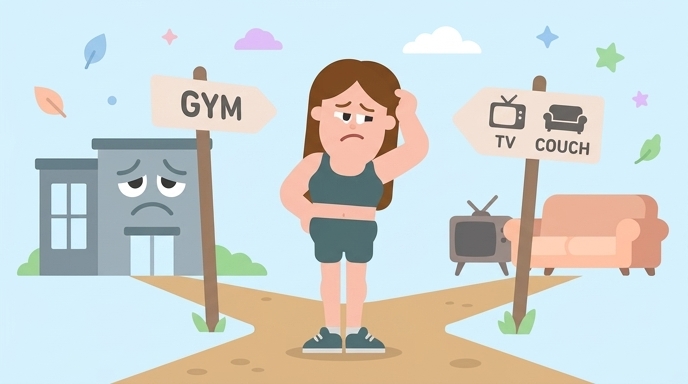
Why You Keep Quitting the Gym (And How to Actually Stick With It)
Most people don't quit the gym because they're lazy. They quit because they're using the wrong tool—willpower—instead of building systems that survive bad days.
You've signed up before. Maybe twice. Maybe four times. The first two weeks felt powerful — and then, somewhere around week three, life happened, you missed a session, then another, and the membership turned into a monthly tax on your guilt.
Here's the part nobody tells you: quitting the gym is not a character flaw. It's the predictable result of using the wrong tool — willpower — for a long-term behaviour problem. This article breaks down why people actually quit, the science of the three-week drop-off, and the systems that work when motivation doesn't.
"Motivation is what gets you started. Habit is what keeps you going." — Jim Ryun
The real reasons people quit (it's not motivation)
When researchers ask people why they stopped training, the answers cluster into a small number of patterns — and "I lost motivation" is almost never the root cause. It's the symptom.
- No clear plan. You show up, wander between machines, leave unsure if it "counted".
- Goals that are too big and too vague. "Get in shape" gives your brain nothing to win at this week.
- No visible progress. The mirror lies for the first 6–8 weeks (here's what really changes and when).
- Friction is too high. 45-minute commute, complicated programs, gym anxiety.
- Identity mismatch. You still see yourself as "someone who's trying to start", not "someone who trains".
In a large meta-analysis on exercise adherence, the strongest predictors of sticking with training weren't motivation or discipline — they were self-efficacy, enjoyment, and routine integration. In other words: feeling capable, having fun, and not having to decide every day.
The three-week drop-off, explained
There is a near-universal curve for new gym-goers:
Week 1–2: The honeymoon
Novelty + dopamine + new gear = high adherence. You feel like a new person.
Week 3: The wall
Novelty fades. Soreness peaks. The first "I'll go tomorrow" appears. One missed session becomes two.
Week 4–6: The fade
Without a system, attendance halves. Guilt rises. The membership stays, the workouts don't.
This isn't laziness. It's how the brain handles novelty: dopamine hits drop off as a behaviour stops being new, and unless something else takes over — structure, identity, or progress — the behaviour quietly dies.
Why willpower is the wrong tool
Willpower is a finite resource. Decades of psychology research show that decision-making and self-control draw from the same mental energy you use for everything else: work stress, family demands, scrolling, even deciding what to eat for dinner.
By 7pm on a Tuesday, after a long day, your "go to the gym" decision is competing with "stay on the couch" — and the couch is winning because it requires zero willpower.
People who train consistently aren't more disciplined. They've simply removed the decision. Training is no longer a thing they choose; it's a thing they do, like brushing their teeth.
Systems that beat motivation
If you want to stop quitting, stop trying harder. Build a system that doesn't need you to feel motivated.
1. Shrink the minimum
Define a "bad-day version" of your workout that takes 10 minutes. Even on your worst day, you can do it. Showing up matters more than the session itself, because every rep is a vote for the person you're becoming.
2. Stack the habit
Attach training to something already non-negotiable: "After I drop the kids off, I drive straight to the gym." No deciding. No "should I?". The cue triggers the behaviour automatically.
3. Make it visible
A streak you can see — on a calendar, in an app, on a chart — turns invisible effort into visible progress. The brain craves completion. Don't break the chain.
4. Lower friction ruthlessly
Pick the gym closer to home, not the nicer one further away. Lay out clothes the night before. Use a pre-built plan instead of designing today's workout from scratch (here's a beginner-friendly weekly structure).
5. Track something other than the mirror
Reps, weight, energy, sleep quality, mood after workouts. Your mirror updates slowly. Your performance updates every session — and that's where the dopamine lives.
How gamification and habit loops fix consistency
Apps like Duolingo didn't make people love grammar — they made showing up feel like a tiny win. The same principle applies to fitness. When every session unlocks XP, extends a streak, or moves you closer to a visible milestone, you stop relying on motivation and start relying on the loop.
A well-designed habit loop has four parts: cue → craving → response → reward. Most fitness apps only handle the response (the workout). Gamified ones handle the craving (anticipation of XP) and the reward (visible progress, streaks, level-ups) — which is why they outperform plain trackers for adherence.
This is exactly the gap Fytly was built for. It's a gamified AI fitness app designed for inconsistent users — people who've quit before and want a system that survives bad days, not another plan that requires perfect motivation.
Stop starting over.
Fytly turns workouts into a game with streaks, XP, and AI-built plans you'll actually finish.
Download Fytly →Frequently asked questions
Why do I keep quitting the gym after 3 weeks?
Because the dopamine hit from novelty fades around week three, and most people have no system in place to replace it. Without structure, identity, and visible progress, motivation alone can't carry the habit through the first slump.
How can I stay consistent with the gym long term?
Stop relying on motivation. Pre-decide your training days, use a fixed plan so you don't choose every session, shrink your minimum workout to 10 minutes for bad days, and track something visible — a streak, performance numbers, or XP.
Is it normal to lose gym motivation?
Completely normal. Motivation is a fluctuating emotional state, not a stable trait. Consistent gym-goers aren't more motivated than you — they've built systems and identities that don't require motivation to function.