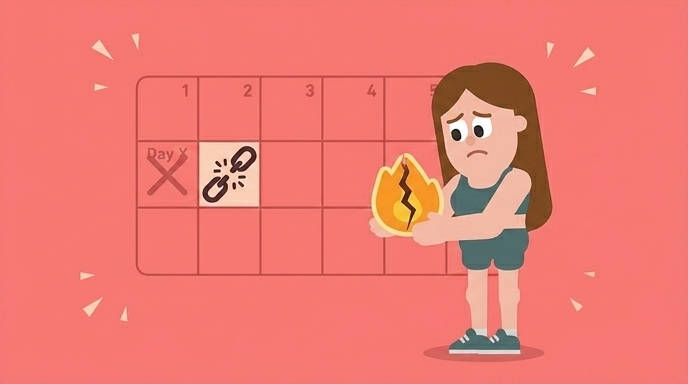
The Real Reason Your Workout Streak Keeps Breaking
Your workout streak keeps breaking around day 14 — and it is not because you are lazy. Here is the all-or-nothing trap, why streaks collapse, and how to design a forgiving streak.
You start strong. Day 3, day 7, day 12 — the streak is glowing. Then life happens: a late meeting, a head cold, a flight. You miss one day. You miss two. By day 16, the streak is gone, and so is your motivation. If this sounds familiar, you're not broken. You're stuck in a poorly designed workout streak system.
Let's break down why streaks collapse — and how to design one that actually survives real life. (Related read: why motivation fails and what to use instead.)
Why Streaks Break Around Day 14
Two-week marks are statistically the most common quit point. According to research from University College London, the brain is still in "effortful" mode during the first 18–66 days of habit formation. Translation: it hasn't gone automatic yet, and the dopamine novelty has worn off. We unpack the full timeline in how long it takes to build a workout habit.
So when life intrudes around day 14, you're at peak fragility — high effort, low reward. One missed day feels catastrophic.
The All-or-Nothing Trap
Most people treat their streak like a glass vase: one drop and it's shattered. This is the all-or-nothing trap. Once the streak breaks, the brain logic goes:
"I broke it. The chain is gone. There's no point continuing this week."
That single missed day cascades into a missed week, then a missed month. The streak didn't kill you. The framing did. The same trap explains why so many people quit the gym entirely.
How to Design a Forgiving Streak
Forgiving streaks survive because they bend instead of break. Build yours with these three rules:
- Two-day rule: Never miss two days in a row. One off-day is recovery; two becomes a pattern.
- Streak freezes: Allow yourself 1–2 "freeze days" per month — planned recovery days that don't break the chain.
- Minimum viable workout: Define a 5-minute version of your workout (a walk, 20 push-ups, a stretch routine). On terrible days, do that. Desk-friendly exercises work great here.
Recovery Days and Streak Preservation
A streak isn't training every single day. That's a recipe for injury. Real consistency includes recovery days by muscle group as part of the plan, not as failures.
Schedule them into your weekly template — see our weekly beginner routine for a clean version:
- 4 training days
- 2 active recovery days (walk, mobility, yoga)
- 1 full rest day
All 7 days count toward your streak. None of them break it.
How Modern Fitness Apps Handle This
The best apps treat streaks as behavioral momentum, not punishment. Fytly's streak system — explored in depth in why gamified fitness apps work — is built around this exact philosophy:
- Recovery and mobility sessions count toward your streak.
- Streak freezes protect you from one-off life events.
- Missed days suggest a "make-up micro-workout" instead of resetting your counter to zero.
The result: users who'd previously quit at day 14 are sustaining 84+ day streaks (the foundation of our 84-Day Reset and 84-Day Comeback Challenge). Ready to start? See how Fytly works.
Frequently Asked Questions
How long does it take for a workout streak to feel automatic?
On average, 66 days according to UCL research — though the range is 18 to 254 days depending on the person and the complexity of the habit.
Should I work out when I'm sick to keep my streak?
No. Train when symptoms are above the neck (mild congestion). Rest fully if symptoms are below the neck (chest, fever, body aches). Use a streak freeze.
What counts as a workout for streak purposes?
Any intentional movement of 5+ minutes — strength, cardio, mobility, yoga, even a brisk walk. Forgiving definitions create durable streaks.
Does Fytly let you freeze your streak?
Yes. Fytly includes streak freezes, recovery-day credits, and make-up micro-workouts so one bad day doesn't undo weeks of progress.